Structured Data for AI Citations: A Practical Schema.org Guide
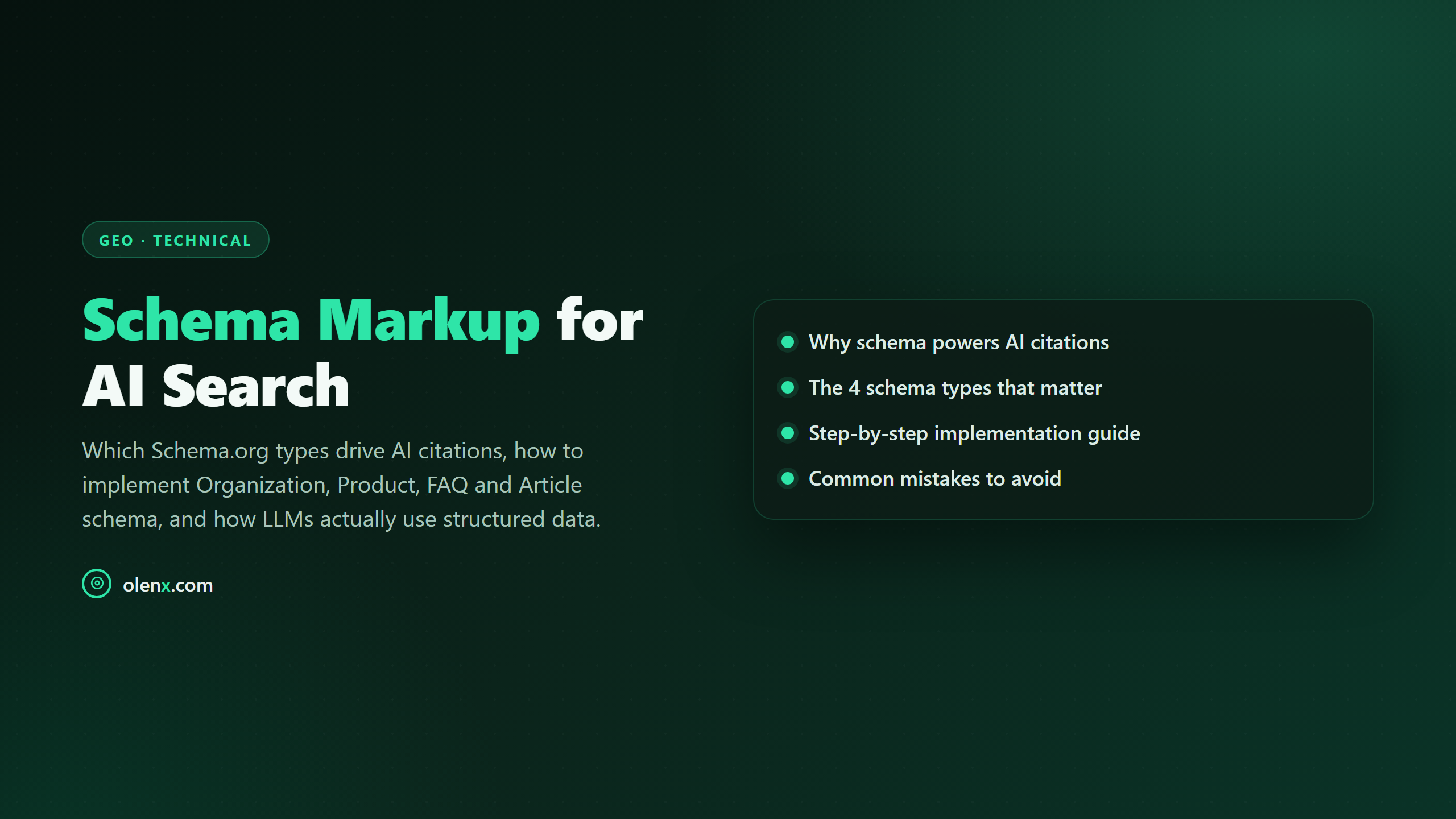
In short — AI assistants don't read your page the way a human does — they parse signals, infer context, and pull structured facts. Schema markup for AI search gives large language models a clean, unambiguous data layer to cite from, making your brand dramatically easier to surface in ChatGPT, Perplexity, Claude, and Google AI Overviews. This guide covers which Schema.org types actually matter for GEO, how to implement each one, and how to verify that AI systems are picking them up.
Why Structured Data Matters More in the AI Era
Traditional SEO used schema to unlock rich results in the SERPs — star ratings, FAQs, breadcrumbs. That was valuable. But the stakes are higher now. AI answer engines don't return ten blue links; they return one synthesized answer, and every word of that answer came from somewhere. The brands that get cited are the ones whose content was easiest to parse, verify, and trust at machine speed.
Schema.org markup is effectively a universal translation layer between your content and an LLM's understanding of it. When you declare @type: Organization and populate name, url, description, and sameAs with your Wikipedia or Wikidata profile, you're collapsing ambiguity. The model stops guessing whether "Olenx" is a software company or a pharmaceutical brand — it knows. That certainty is what earns citations.
This matters alongside other technical signals. As we cover in llms.txt, robots.txt and Schema for AI Search, schema is one pillar of a broader technical foundation that controls how AI crawlers index and represent your brand.
ChatGPT weekly active users — the audience your schema now needs to impress (Search Engine Land)
Monthly users reached by Google AI Overviews, powered partly by structured data signals (Digiday)
The Four Schema Types That Drive AI Citations
Not all schema is equal in the context of GEO. These four types consistently correspond to how AI assistants categorise, quote, and recommend brands and content.
Establishes who you are at the entity level. Populating name, legalName, url, logo, description, and crucially sameAs (LinkedIn, Crunchbase, Wikidata) gives LLMs a canonical identity to anchor citations to. Without it, your brand is an unresolved string.
Critical for e-commerce and SaaS. Product schema with name, description, offers, aggregateRating, and brand lets AI assistants answer "what does X cost?" or "is X well-rated?" with attributable precision rather than hedged generalities.
The most directly GEO-native schema type. Each Question/Answer pair is a pre-packaged, self-contained response that AI systems can lift almost verbatim. Perplexity, in particular, shows a measurable preference for content that already frames itself as an answer.
Declares authorship (author), recency (datePublished, dateModified), and topic scope (about, keywords). AI models weight recency and authorial credibility heavily when deciding what to cite as an authoritative source.
How to Implement Each Type: Step by Step
JSON-LD injected into the <head> is the recommended format — it's the cleanest for crawlers and doesn't require touching visible HTML. Here's a practical implementation sequence for a SaaS or content-heavy site.
Deploy Organization schema site-wide. Place a single @type: Organization JSON-LD block in your global <head> template. Include sameAs links to every authoritative third-party profile: LinkedIn, Crunchbase, Wikidata, GitHub, and any industry databases. This anchors your entity across the entire web graph that LLMs train and retrieve from.
Add Article schema to every editorial page. Populate headline, author (with a nested Person type and the author's social profiles in sameAs), datePublished, dateModified, and publisher. Keep dateModified accurate — AI systems use freshness as a trust proxy, especially for rapidly evolving topics like GEO.
Mark up FAQs on every question-driven page. Identify the three to five most common user questions your page answers, write concise 40–80-word answers, and wrap them in FAQPage schema. Align the language in the schema with the language on the page — inconsistency signals low quality to both Google's validators and AI retrievers.
Implement Product schema on all product and pricing pages. Use aggregateRating only if you have genuine review data; fabricated ratings are detectable and erode trust. Connect Product to your Organization via the brand property to reinforce entity relationships across your schema graph.
Validate and monitor continuously. Run every page through Google's Rich Results Test after deployment. Then use Olenx to track whether AI assistants are actually citing your pages — structured data is necessary but not sufficient; you need visibility data to close the loop. See our guide on how to track your brand's AI visibility for the full monitoring workflow.
How AI Systems Actually Use Schema Signals
It's worth being precise about the mechanism here, because the relationship between schema and AI citations is more nuanced than "add schema, get cited."
Large language models are trained on web crawls. During training, structured data in JSON-LD or microdata formats is parsed and used to label entities, disambiguate mentions, and build internal knowledge representations. Schema doesn't guarantee citation — but it reduces the friction that causes models to misrepresent or ignore a brand entirely.
At retrieval time (in RAG-based systems like Perplexity or Bing Copilot), structured data helps the retrieval layer understand page topic and entity relevance faster. A page with a well-formed FAQPage schema is effectively pre-chunked for retrieval — each Q&A pair maps cleanly to a probable user query. That's a meaningful advantage over unstructured prose.
For Google AI Overviews specifically, structured data interacts with Google's Knowledge Graph. Pages that use Organization schema with sameAs links to established entities are more likely to be treated as authoritative nodes rather than anonymous content. Read more on this in our dedicated guide to how to appear in Google AI Overviews.
Gartner's projected drop in traditional search engine volume by 2026 — meaning structured data optimised for AI answers must become a first-class priority, not an afterthought (Gartner).
Common Schema Mistakes That Hurt AI Visibility
Implementation errors are more damaging in a GEO context than in traditional SEO, because AI systems have no tolerance for contradictions. A mismatch between your schema and your visible content doesn't just forfeit a rich result — it can actively reduce a model's confidence in your brand as a source.
FAQPage schema contains answers not visible on the page. Google's crawler flags this as manipulative; AI systems flag it as unreliable. Every schema claim must have corresponding on-page content.sameAs on OrganizationdateModifiedsameAs links provides zero E-E-A-T signal. Named authors with verifiable profiles (LinkedIn, Google Scholar, industry bios) dramatically improve content trustworthiness in AI systems.llms.txt, permissive robots.txt for AI crawlers, and substantive content that earns citations organically. For the full picture, see a GEO content strategy that earns citations.Schema as Part of a Broader GEO Strategy
Structured data is foundational, but it's one instrument in a larger orchestra. The brands consistently cited by AI assistants combine technical schema hygiene with authoritative content, strong entity presence across third-party sources, and ongoing measurement. Schema tells the machine what you are. Your content, backlinks, and brand mentions tell it whether to trust you.
If you're building out your approach from scratch, The Complete Guide to GEO in 2026 maps the full framework. Schema implementation slotting into the technical foundation layer — essential to get right before investing in content production or authority building.
For verticals with specific schema considerations — product catalogues in e-commerce, service listings in fintech — the entity types and implementation priorities shift. The principles here remain constant; the schema types you prioritise scale with your business model.
Is your schema actually driving AI citations?
Olenx audits your structured data, entity presence, and brand visibility across ChatGPT, Perplexity, Claude, and Google AI Overviews — and shows you exactly what to fix.
Run my free audit →FAQ
Does schema markup directly cause AI assistants to cite my content?
Not directly — schema doesn't flip a citation switch. It reduces ambiguity about your entity and content, making it easier for AI systems to parse, trust, and reference your pages. Think of it as a prerequisite rather than a guarantee: without it, you're competing with one hand tied behind your back.
Which schema type is most important for GEO?
Organization with sameAs references is the most foundational because it establishes your brand as a known, verifiable entity. After that, FAQPage has the most direct impact on AI answer generation because each Q&A pair maps to a natural query format that AI systems retrieve against.
Should I use JSON-LD, Microdata, or RDFa?
JSON-LD is the clear recommendation. Google explicitly prefers it, it's easy to maintain independently of HTML structure, and modern CMS plugins (Yoast, Rank Math, Schema App) generate it natively. Microdata and RDFa still work but create maintenance complexity with no meaningful benefit for AI citation purposes.
How do I know if my schema is being picked up by AI systems?
Start with Google's Rich Results Test and Schema Markup Validator for structural correctness. For actual AI citation tracking — whether ChatGPT, Perplexity, or Gemini is citing your structured pages — you need a GEO monitoring tool like Olenx, which tracks brand mentions across AI assistants and correlates them with your technical setup.
Sources
- ChatGPT has around 900 million weekly active users — searchengineland.com
- Google's AI Overviews reach over 2 billion monthly users — digiday.com
- Gartner predicts traditional search engine volume will drop 25% by 2026 due to AI chatbots and virtual agents — gartner.com
Ready to optimize your AI visibility?
Get your free AI visibility audit and discover your mention rate.
See if ChatGPT cites meThe Olenx Team
Generative Engine Optimization engineers. Olenx measures brand visibility on ChatGPT, Claude, Perplexity and Gemini.
Related articles
llms.txt, robots.txt and Schema for AI Search
Master the technical GEO foundation: understand what llms.txt, robots.txt, and schema markup actually do for AI search visibility—and where each one falls short.
How to Appear in Google AI Overviews
Google AI Overviews now reach 2 billion monthly users — and they pick sources differently than classic search. Learn how to optimize your content to get cited.
Building Brand Authority That LLMs Cite
Learn how to build the off-site brand authority that makes LLMs like ChatGPT, Claude, and Perplexity cite your brand — from third-party coverage to consistent entity signals.