How to Appear in Google AI Overviews
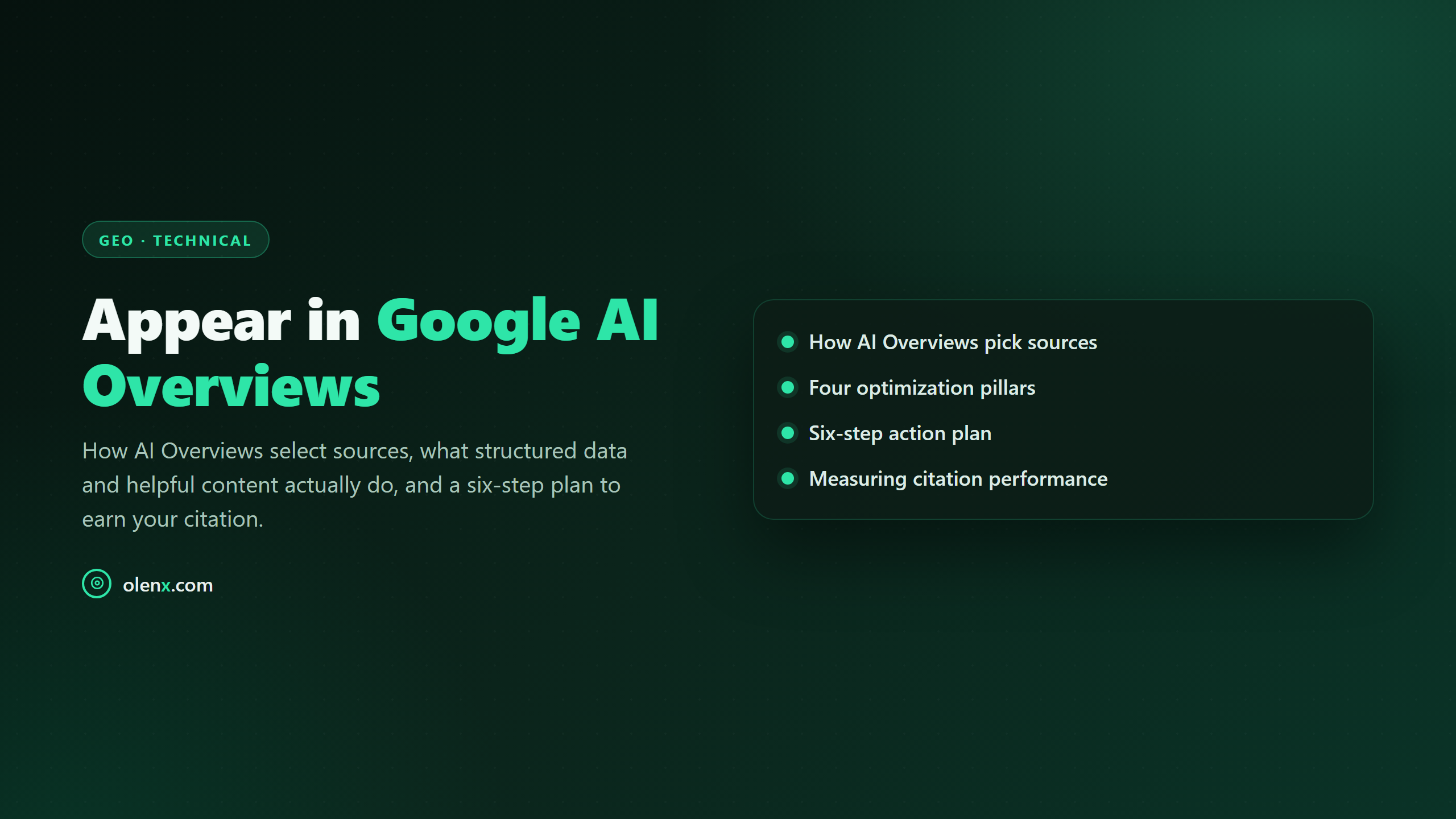
In short — Google AI Overviews synthesize answers from a curated set of sources, bypassing the traditional blue-link ranking logic. To appear in them, you need to satisfy a distinct set of signals: demonstrable expertise, structured data, and content shaped for direct extraction. This guide breaks down exactly how the selection mechanism works — and what to do about it.
Why AI Overviews Are Now Non-Negotiable
Google AI Overviews are no longer a beta experiment. They surface across a massive share of informational, commercial, and navigational queries — and they have the audience to match. Two billion monthly users encounter AI-generated answers before they ever see an organic result. For any brand that depends on search-driven discovery, being excluded from that layer is no longer a rounding error; it's a structural visibility problem.
The dynamic is straightforward: when Google's generative layer provides a confident, sourced answer, click-through rates on traditional results fall. Appearing inside the overview — as a cited source — partially compensates for that loss and, more importantly, builds the kind of brand-level authority that AI assistants propagate across the web. As we detail in our GEO vs SEO comparison, the optimization playbook has meaningfully shifted.
Monthly users reached by Google AI Overviews (Digiday)
Projected drop in traditional search volume by 2026 (Gartner)
How Google AI Overviews Actually Pick Sources
Google has not published a precise retrieval algorithm for AI Overviews, but its documentation, quality rater guidelines, and observable citation patterns reveal a coherent picture. The system does not simply pull from page-one rankings. It runs a secondary evaluation pass that scores pages on several dimensions simultaneously.
The Four Pillars of AI Overview Optimization
Optimizing for AI Overviews requires work across four interconnected dimensions. Strength in one cannot fully compensate for weakness in another — Google's generative layer is holistic, not additive.
Write for the searcher's actual task, not for a keyword. Satisfy the full intent — definition, nuance, caveats — without padding. Google's Helpful Content system down-weights content that exists primarily to rank.
Implement FAQPage schema on Q&A sections, HowTo schema on step-by-step guides, and Article schema with author and dateModified fields site-wide. This reduces the extraction burden on the model. See our Schema.org practical guide for implementation details.
Build a content cluster around each core topic. Individual pillar pages signal comprehensiveness; internal links tell Google's crawler — and its generative layer — that your site owns the subject space.
Named authors with credential bios, a transparent editorial policy, clear organization schema, and inbound links from authoritative sources all build the E-E-A-T profile that AI Overviews favor.
Step-by-Step Optimization Plan
The following sequence moves from audit to execution. Work through each step before proceeding to the next — later steps depend on the foundation laid earlier. For a broader framework, see The Complete Guide to GEO in 2026.
Audit your current AI Overview presence. Run your priority queries in Google and record whether an AI Overview appears, whether your domain is cited, and which competitors are sourced. This baseline is your benchmark — without it, optimization is guesswork.
Map content to query intent clusters. Group your target keywords by the underlying task (learn, compare, do, buy). For each cluster, identify which page — if any — satisfies that intent fully. Gaps become new content briefs.
Rewrite introductions for direct answerability. Add a concise summary block — 2–4 sentences that answer the query directly — at the top of every target page. This is the passage Google's model is most likely to extract verbatim.
Implement structured data on every eligible page. Use FAQPage markup for Q&A sections, HowTo for step-based content, and Article with author, publisher, and dateModified on all editorial pages. Validate with Google's Rich Results Test before deploying.
Strengthen your E-E-A-T signals. Add author bios with credentials and social profiles, link to primary sources for every factual claim, create or update an About page and editorial guidelines page, and pursue coverage or quotes in third-party publications within your niche.
Monitor, iterate, and expand. Re-run your audit queries weekly. Track which pages earn citations, which lose them, and what changed on the competing pages that displaced you. Use those signals to continuously refine content and structure.
The llms.txt Question
A growing number of marketers ask whether adding an llms.txt file — a plain-text page listing your content for LLM crawlers — improves AI Overview inclusion. The honest answer is: probably not on its own.
Only 10.13% of sites currently have an llms.txt file, and research shows no proven correlation between its presence and AI citations (SE Ranking).
That doesn't mean the file is useless — it's a low-effort signal of intent toward AI crawlers and may provide marginal benefit as adoption grows. But it should sit at the bottom of your optimization backlog, not the top. Invest in content quality and structured data first. We cover the full technical picture in llms.txt, robots.txt and Schema for AI Search.
Measuring What's Working
Traditional rank tracking doesn't capture AI Overview presence. You need a dedicated measurement layer that monitors citation frequency, co-citation context, and answer positioning across your target query set. Olenx was built specifically to fill that gap — it continuously probes AI engines including Google AI Overviews, scores your brand's presence, and surfaces the content and competitor signals that explain your citation rate. The data turns a historically opaque optimization process into a closed feedback loop.
For a deeper look at which numbers actually move the needle, see The GEO Metrics That Actually Matter.
Is your brand showing up in Google AI Overviews?
Run a free Olenx audit and see exactly where you're cited — and where you're invisible.
Run my free audit →FAQ
Do I need to rank on page one to appear in Google AI Overviews?
Not necessarily. AI Overviews pull from a secondary evaluation layer that scores topical authority, E-E-A-T, and extractability independently of traditional ranking position. Pages ranked #5–#15 are regularly cited if their content is more directly answerable and better structured than higher-ranking competitors.
Which schema types matter most for AI Overview optimization?
FAQPage and HowTo schemas provide the clearest extraction signals because they map directly to the Q&A and step-based formats that AI Overviews favor. Article schema with author and dateModified fields adds E-E-A-T and freshness context. Implement all three where your content fits the format.
How quickly can I expect to see results after optimizing?
AI Overview citations can shift faster than traditional rankings — sometimes within days of a crawl following a content update. However, trust signals like E-E-A-T and inbound authority build over weeks to months. Prioritize structural and content changes first for the fastest measurable impact.
Does Google AI Overviews optimization differ from optimizing for ChatGPT or Perplexity?
The underlying principles — authoritative content, structured data, clear answers — are shared. But each platform has its own retrieval architecture. Google AI Overviews are more tightly coupled to Google's existing index and quality signals, while ChatGPT and Perplexity use different source-selection mechanisms. A strong GEO strategy addresses all of them systematically.
Sources
- Google AI Overviews reach over 2 billion monthly users — digiday.com
- Gartner predicts traditional search engine volume will drop 25% by 2026 — gartner.com
- llms.txt present on only 10.13% of sites, no proven correlation to citations — seranking.com
Prêt à optimiser votre visibilité IA ?
Recevez votre audit de visibilité IA gratuit et découvrez votre taux de mention.
Voir si ChatGPT me citeThe Olenx Team
Ingénieurs en Generative Engine Optimization. Olenx mesure la visibilité des marques sur ChatGPT, Claude, Perplexity et Gemini.
Articles liés
Structured Data for AI Citations: A Practical Schema.org Guide
Schema markup for AI search is no longer optional. Learn which Schema.org types—Organization, Product, FAQ, Article—drive AI citations in ChatGPT, Perplexity, and Google AI Overviews, plus how to implement them right.
llms.txt, robots.txt and Schema for AI Search
Master the technical GEO foundation: understand what llms.txt, robots.txt, and schema markup actually do for AI search visibility—and where each one falls short.
Building Brand Authority That LLMs Cite
Learn how to build the off-site brand authority that makes LLMs like ChatGPT, Claude, and Perplexity cite your brand — from third-party coverage to consistent entity signals.